
You learn history at school. Why not futures?
The future isn't something that happens to you. It's full of patterns you can spot, possibilities you can explore, and choices you can make right now. We teach young people how.
Learn To Navigate
〰️
Learn To Navigate 〰️
Equipping young South Australians to navigate an uncertain world.
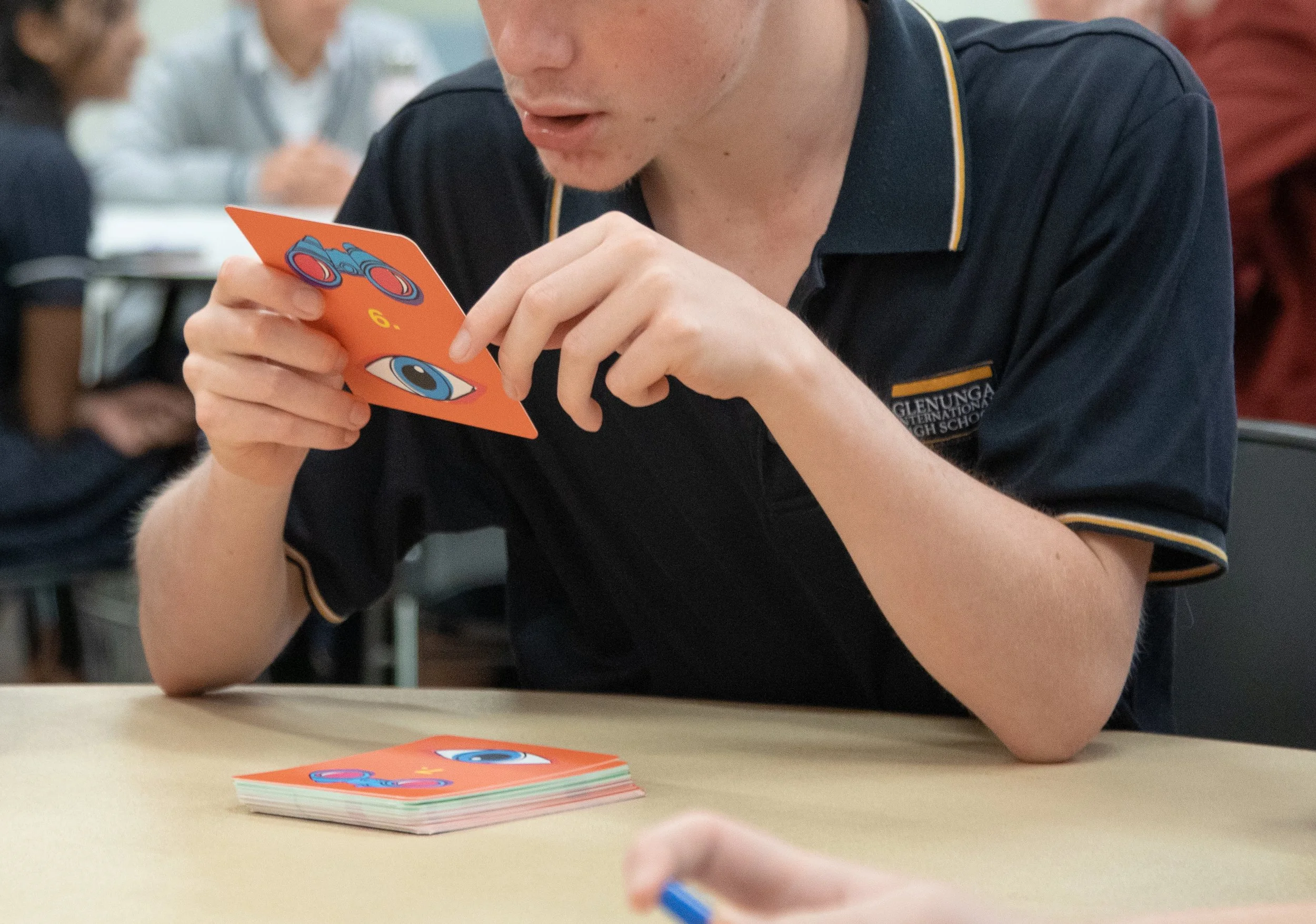
Youth Futures is SA Futures Agency's education program for secondary students and young adults up to 25.
We take the same world-class foresight methods used by governments and organisations, and teach them through games, creativity, collaboration and real conversations.
Because the future belongs to people who know how to think about it.

-

Workshops
Creative, hands-on sessions designed around learning by doing. Whole day, half day, or 1-2 hours. We can host or come to you.
-

Games
Card games and role-playing games that build real foresight capability through play. Futures thinking, gamified.
-

Talks
Connecting you with diverse thinkers and practitioners who use futures thinking in their everyday lives.
-

Mentoring
One-on-one or small group support for navigating your own futures with confidence.
-
Teacher Training
Building teacher confidence in futures methods to bring this into classrooms everywhere.
-
Digital Reources
Interactive tools and games so you can keep building your foresight skills anywhere, anytime.
Learn to Navigate.
The world is shifting fast. Climate, technology, geopolitics, culture. Nobody can predict exactly what's coming. But you can learn to navigate it.
Youth Futures teaches you four core foresight skill domains that work together to help you read the landscape, explore what's possible, choose your direction, and move towards the futures you want. Even when the ground keeps shifting.
Once you have these skills, you use them all to navigate. Your destination: the future you want.

01. Sense
Spot what's shifting before everyone else does
The world is constantly throwing off signals of change: a new technology, a shifting attitude, a surprising event. Most people scroll right past them. You'll learn to notice them, name them, and figure out what they might mean. Signals, trends, currents, counter-currents and issues: this is your early warning system. Not just from data, but from lived experience, conversation, and paying attention to what's happening on the ground and beyond the digital.
The question: What do we think will probably happen?
02. Imagine
Explore many futures, not just one
Planning for a single future is fragile. The world is too complex and surprising for that. With scenario thinking, you'll learn to hold multiple possible futures in your mind at once, exploring how different forces could combine to create wildly different worlds. It's not about predicting. It's about preparing, stretching your imagination, and testing your assumptions.
The question: What could possibly or plausibly happen?
03. Aspire
Get clear on the future you actually want
This is about values. What kind of world do you want to live in? What kind of future do you want to create for yourself? Visioning helps you name what "good" looks like so you've got a destination, not just a map. Your aspirations give your decisions direction and your hope a place to take root.
The question: What do we want (or not want) to have happen?
04. Act
Work backwards from the future you want to the steps you take today
Hope without action is just a wish. Through backcasting, strategy, and working together across different perspectives, you'll learn to map the pathway from where you are to where you want to be, then stress-test it against different scenarios. Then it's about getting busy with the doing, and learning from what we do, and we loop back to Sense and start again.
The question: What are we going to do about it?
Creativity runs through everything.
Foresight isn't dry or academic. Every stage takes creativity: noticing what others miss, building imaginary worlds, dreaming up the future you want, finding clever paths to get there. We teach through games, art, collaboration and conversation, because the future belongs to creative thinkers.
How we do it:
-
Hands-on sessions designed around learning by doing. Whole day, half day, or 1-2 hours. We can host or come to you.
-
Card games and role-playing games that build real foresight capability through play. Futures thinking, gamified.
-
Connecting you with diverse thinkers and practitioners who use futures thinking in their everyday lives.
-
One-on-one or small group support for navigating your own futures with confidence.
-
Building teacher confidence in futures methods to bring this into classrooms everywhere.
-
Interactive tools and games so you can keep building your foresight skills anywhere, anytime.

What you'll learn
We take the same powerful methods used by futurists around the world and teach them through games, creativity, collaboration and real conversations. Here's what's in the toolkit.
-
Horizon scanning basics and terminology: signals, currents and counter-currents, trends, issues, megatrends
STEEP+V scanning (Social, Technological, Economic, Environmental, Political, Values)
Importance vs uncertainty: sorting what matters most
Blind spots, bright spots, critical uncertainties and action priorities
Building your own signal radar
Three Horizons: reading change across different timeframes
Collective sensing and sense-mak
-
Scenario basics: what scenarios are (and aren't)
Two-axes method: building 2x2 scenario frameworks
Branching futures and morphological analysis
Scenario archetypes: Growth, Collapse, Restraint, Transformation
Storytelling: bringing scenarios to life with vivid, human narratives
Deeper layers of meaning: myths, metaphors and Causal Layered Analysis
Working with scenarios: reading, reflecting, and using them as lenses
-
Values: understanding what matters and why
Visioning techniques: meditative, reflective, creative, visual, textual and story-based approaches to imagining what good looks like
Goal setting: turning vision into clear, meaningful objectives
-
Backcasting: working backwards from the future you want to the steps you take today
Pathways: mapping multiple routes forward and stress-testing them against scenarios
Doing, learning, adapting: the cycle of action, reflection and adjustment
-
Building emotional resilience for navigating uncertainty and change
Hope as strategy: the Stockdale Paradox, realistic hope, and actionable optimism
Looking after yourself while looking ahead: managing eco-anxiety, future-shock and overwhelm
Finding agency: wherever you are, you can always take a step
-
Creating safe, generative spaces for thinking together about the future
Respect, inclusion and the value of diverse perspectives
Call in, not call out: how we hold space for difference
Bias checks, shadow sensing and asking "whose voices are missing?"
Who we are

Youth Futures is a program of SA Futures Agency, South Australia's home for strategic foresight, based at Lot Fourteen on Kaurna Country.
It is led by two of our team members, Brooke Ferguson and Dani Valentine, with support from all members of our team, especially Ariella Helfgott and Stavroula Adameitis.
As experienced young practitioners themselves, Brooke and Dani understand the challenges and opportunities of your generation and believe that with the right tools, young people can move towards their preferred futures with actionable hope.
Built on respect. Open to everyone.
Futures thinking is most powerful when it is participatory and collective. We all have blind spots, and by working together across different ways of knowing and seeing, we can better anticipate change, enable action, and shape better futures.
Aboriginal and Torres Strait Islander peoples have practised deep knowledge of time, place, Country, and future-making for tens of thousands of years. We honour that knowledge and are committed to collaboration that furthers self-determination.
In our spaces, we don't just dump signals. We make sense together. We call in, not call out. We ask whose voices are missing. We check our biases. And we know that culture isn't a side note. It's the soil in which everything grows.

Whether you're a school, a youth group, a community organisation, or just a curious human who wants to understand the future better: we'd love to hear from you.