The US–Iran Standoff: What It Could Mean for South Australia
A navigation guide for our families, our communities, and our budgets.
Words by Professor Ariella Helfgott.
Why We Wrote This
When a crisis erupts on the other side of the world, most of us feel one of two things: anxiety, or helplessness. Often both. The news tells you what happened. It doesn’t tell you what it means for you, or what you can do about it.
That’s the gap this briefing tries to fill. We’re not here to predict what will happen, nobody can do that. We’re here to help you think through what might happen, what each possibility would mean for South Australia, and where you have choices. Because you do have choices, even when it doesn’t feel like it.
This is what foresight does. Not crystal-ball gazing. Not doom-scrolling with footnotes. Just a structured way of looking at uncertainty so you can prepare rather than react, and act rather than freeze.
The Situation Right Now
The United States has assembled its largest military force in the Middle East since the 2003 Iraq invasion. On 20 February, the President gave Iran 10–15 days to agree to a nuclear deal or face “really bad things.” He has confirmed he is considering limited strikes. A presidential adviser has put the odds of military action at 90%. A third round of indirect talks is scheduled for Geneva on 27 February, with Iran preparing a draft proposal – but significant gaps remain between the two sides. This is not the first time this pattern has played out: last year, a 60-day deadline expired without a deal, and the US and Israel struck Iran’s nuclear facilities in June 2025. We are now in the second cycle of deadline, buildup, and brinkmanship.
If you’re an Iranian-Australian reading this, if you have family in Iran, if you’re watching the news with a knot in your stomach that the rest of us can only imagine, we feel for you. We’re about to talk about oil prices and freight costs, because those things matter and they’re coming. But the most important thing at stake in this crisis is people’s lives. Your fear for the people you love is not a footnote in this story. It’s the centre of it. Everything else is consequences. For the rest of us, here’s why a military standoff 11,000 kilometers away is about to arrive in your household.
The Connection to Your Life in SA
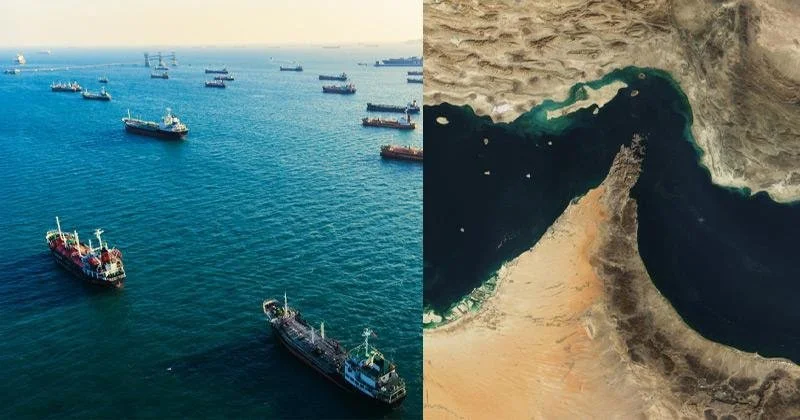
Roughly 20% of the world’s oil supply passes through the Strait of Hormuz, the narrow waterway next to Iran. It is, to use a technical term, a chokepoint. As in, if someone chokes it, the whole world feels it.
Oil prices have already risen nearly 20% this year on the tension alone. Brent crude started January at around $61 a barrel. It's now above $71. And nobody has fired a shot yet. You may not have felt that at the bowser yet, because there's always a lag between global oil markets and Adelaide pump prices. That lag isn't protection. It's lead time.
The AMP chief economist puts the rule of thumb simply: every $10 per barrel increase adds roughly 10 cents per litre at the Australian bowser. That’s not a forecast. It’s arithmetic.
If you live in regional SA, distance means more fuel per trip, more freight cost per grocery item, more exposure per household. The people with the fewest choices will pay the most. That’s true of most crises. It doesn’t have to stay true. We’ll come back to that.
Three Ways This Could Go, And What Each Means for Your Decisions
Nobody knows how this ends. But we can map the main possibilities, and that’s where it gets useful.
What you’re about to see is a set of scenarios - not predictions, not forecasts, but the structured range of what experts consider plausible. Most people think scenarios are about long-term planning, but they’re just as powerful when you need to make decisions under uncertainty right now: what do I budget for this month? What do I tell my staff? What should I ask my MP?
You don’t need to know which future is coming. You need to see the range so you can prepare for what’s plausible. That’s the whole point. If you can look at these three possibilities and think “I could handle that if I did X,” you’re already ahead of most people. That’s foresight working.
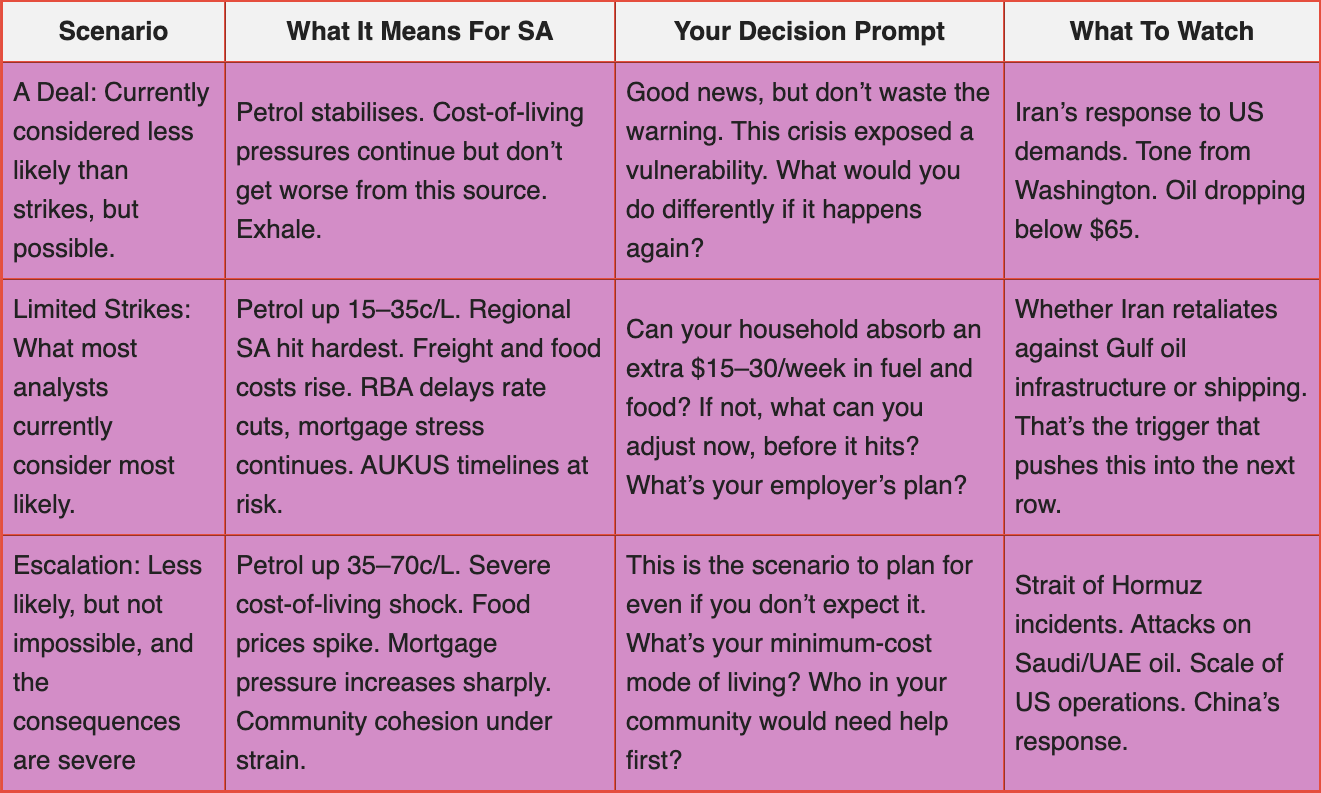
Sources: CSIS, Columbia CGEP, Lombard Odier, AMP, AIIA, CNN, NBC, Al Jazeera, Axios, UK House of Commons Library. All open-source, February 2026.
There’s a fourth possibility we haven’t tabled: that none of these happens cleanly. That the standoff just drags on, no deal, no strikes, just months of tension and oil prices sitting uncomfortably high. In some ways, that’s the hardest scenario to prepare for, because there’s no clear signal telling you to act. If you’re the kind of person who only reacts to a crisis when it becomes undeniable, this one could sneak up on you.
One more thing these scenarios don’t show: regime change in Iran. It could emerge from either strikes or escalation, as an unintended consequence, or as the explicit goal of a sustained campaign. Fresh student protests erupted across Tehran universities in late February 2026, following a brutal crackdown on nationwide protests in January that killed thousands. Internal instability is rising. Either way, regime change would mean a years-long US commitment that reshapes every assumption about American capacity to deliver on AUKUS. It would also mean mass displacement, regional instability, and pressures on community cohesion here in SA. We flag it not as a prediction but as the kind of second-order consequence that short-term scenarios can miss if you’re not watching for it.
The $30 Billion Question
On 15 February, the Commonwealth announced $3.9 billion for the Osborne Submarine Construction Yard. Projected total investment: $30 billion. Nearly 10,000 SA jobs at peak. This is, by any measure, the biggest economic bet on South Australia in a generation. Both major parties support it.
Here’s the catch: those submarines depend on US naval production capacity. America currently builds roughly two Virginia-class submarines a year for its own navy. If it’s simultaneously fighting a war in the Middle East, that production line faces competing demands.
The Australian Institute of International Affairs has said the quiet part out loud: the real question for Australia isn’t what happens in Tehran. It’s about capacity to deliver here while fighting a war elsewhere.
If your job, your business, or your community’s future is tied to Osborne, this is a question worth asking your MP, whichever party they belong to. Not as criticism of the alliance. As common sense. And as a prompt to think about what Plan B looks like, not because you expect to need it, but because having one makes you more resilient.
Here’s the good news in all of this: building sovereign industrial capability in SA is the right move in every scenario. If a deal holds and AUKUS proceeds on schedule, SA companies are ready. If timelines slip, the skills, facilities, and supply chains we’re building here have value far beyond submarines, in advanced manufacturing, aerospace, and export markets. The investment in local capability is not wasted in any future. Right now, Osborne will build the hulls, but the highest-value systems, the combat control architecture, the nuclear reactor, the sonar and sensors, are designed in the US, UK, and Europe. That’s normal for a program this early. But the next frontier for SA is ensuring our companies and researchers move up the value chain from physical fabrication into the technology and systems work where the real long-term value sits. AUKUS Pillar II, covering AI, quantum, cyber, and autonomous undersea systems, is where that opportunity lives, and SA already has capability in six of its eight technology areas.
These are real companies, employing real South Australians, building real things, and every one of them becomes more valuable as our sovereign capability grows, regardless of what happens in the Strait of Hormuz.
Energy: Where SA Has More Agency Than You Think
Energy policy in South Australia is politicised and polarised, to put it mildly. People hold genuinely different views about the right energy mix, and we respect all of them. This briefing does not take sides.
But this crisis does require us to be honest about two facts that are true regardless of anyone’s energy philosophy:
Fact 1:SA’s electricity is substantially generated from sources located in this state. Whatever you think about how we got here or whether the mix is right, the practical result is that our electricity supply is less exposed to a global oil shock than states that import more of their fuel. Wholesale electricity prices in SA fell 30% in late 2025 to among the lowest in the country.
Fact 2: That protection does not extend to what hurts most right now - every litre of petrol and diesel we buy is priced on world oil markets. Our transport, our freight, our farms, our regional supply chains, completely exposed to whatever happens in the Strait of Hormuz. And we still face some of the highest retail electricity prices in the country, driven by network costs and market structure that exist regardless of the generation mix.
Both things are true at the same time. Acknowledging one doesn’t cancel out the other.
The gap this crisis exposes is between SA’s locally generated electricity and its complete dependence on imported fuel for transport, freight, and agriculture. South Australia is not yet in control of the energy its people need to get to work, move goods to market, and run their farms.
Here’s the thing, though: this is a gap that can be closed. People who think the answer is electrification and batteries, people who think it’s hydrogen and alternative molecules, people who think it’s domestic gas, and people who think it’s something else entirely can all agree on the diagnosis: the gap needs closing. South Australia has been a genuine world leader in renewable electricity, that’s the protection we already have. But the transport fuel gap keeps not getting closed. The state’s flagship $593 million Hydrogen Jobs Plan at Whyalla was deferred last year when the steelworks needed rescue, an understandable choice in a crisis, but one that left the original vulnerability untouched. The Office of Hydrogen Power SA has since been dissolved. The Port Bonython Hydrogen Hub continues, the federal government is backing hydrogen production with a $2-per-kilogram tax incentive, and nearly 4,000 Adelaide homes still receive hydrogen-blended gas. Others argue the path runs through domestic gas or electrification. The debate about how to close the gap is legitimate. The fact that it remains open is the point.
Every step toward fuel independence, by whatever path, is a step toward being less at the mercy of decisions made in rooms we’ll never enter. That’s not ideology. That’s sovereignty.
What You Can Actually Do
You can’t control what happens in the Strait of Hormuz. But you’re not powerless. Here are five things that are entirely within your reach:
1. Know your exposure. Look at what your household spends on fuel. If it’s a lot, think about what options might reduce that, whatever those look like for your situation. This isn’t about ideology. It’s about not being at the mercy of things you can’t control.
2. Budget for disruption, not disaster.The most commonly expected scenario adds 15–35 cents per litre. If you can build a buffer into your budget now, before it hits, that’s one less surprise. Preparing isn’t pessimism. It’s the opposite, it’s giving yourself room to stay calm.
3. Ask your MP.Whatever party they represent, they should be able to tell you what the state’s plan is if petrol hits $2.50 a litre. If they can’t, that’s worth knowing.
4. Look after the people around you.Cost-of-living stress is already high. If it gets worse, the people who’ll struggle most are the ones already struggling, people on fixed incomes, in regional communities, on tight margins. South Australia has always been good at looking after its own. That’s going to matter.
5. Be kind to your neighbours. Iranian-Australians and other Middle Eastern diaspora communities in SA are watching this crisis with a fear most of us will never fully understand. They are our colleagues, our kids’ classmates’ parents, our neighbours. Crises like this can strain community bonds or strengthen them. That’s a choice, and it’s ours.
The Bigger Picture
The US–Iran standoff isn’t happening in isolation. It’s unfolding alongside trade tensions with China that affect SA’s commodity exports, disruptions to global shipping, and what analysts are calling a broader fragmentation of the international order. These things interact: supply chain disruptions compound, alliance commitments compete for finite resources, and economic shocks cascade.
South Australia is more connected to these global forces than most of us realise. The price at the pump, the timeline for submarines at Osborne, the cost of freight to the regions, the interest rate on a mortgage in the suburbs, all of these are now being shaped by decisions made in Washington, Tehran, and Beijing.
That’s not a reason to panic. It’s a reason to pay attention. And it’s a reason to build the kind of resilience in our households, our communities, and our state, that means we’re less vulnerable next time. Because there will be a next time.
A Final Thought
The most resilient households and communities are the ones that can do two things at the same time: face the full reality of what might go wrong, and stay committed to building something better. That’s not optimism. It’s not pessimism. It’s the discipline of refusing to choose between honesty and hope.
We wrote this briefing because we believe every South Australian deserves the tools to understand what’s happening and make good decisions for their family and community. You don’t need a degree in international relations. You don’t need to follow the news 24/7. You just need to lay out the possibilities clearly, figure out what to watch for, and remind yourself that you’re not powerless.
That principle doesn’t belong to any political party. It belongs to all of us.